From Craft to Infrastructure
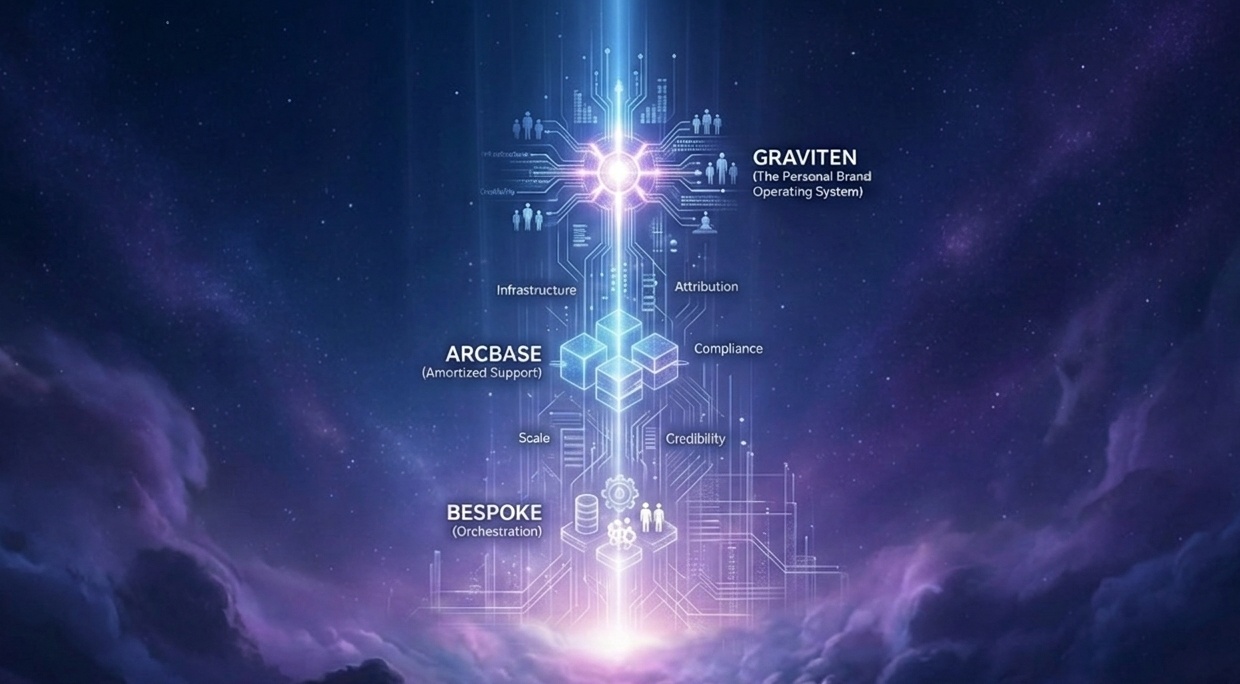
Why We Moved from Bespoke Services to a Personal Brand Operating System
For the first seven years of Arcbound, we built everything by hand.
Not because we wanted to.
Because there wasn’t another way.
Arcbound began as a high-touch personal brand firm. We worked across PR, speaking, publishing, podcast production, LinkedIn strategy, newsletters, partnerships — assembling entire ecosystems around individuals who had something meaningful to say.
From the outside, it looked like marketing.
From the inside, it was orchestration.
A writer.
A designer.
A website developer.
A podcast team.
A videographer.
A performance ads specialist.
Project management.
Distribution.
Reporting.
Speaking opportunities.
Partnership coordination.
The talent wasn’t the problem.
The structure was.
To get one person’s voice into the world consistently required stitching together a small village. And maintaining that village required constant coordination, taste, discipline, and patience.
You weren’t just building content. You were building trust systems.
And trust systems don’t compound in 90 days. They compound over years.
Which meant the economics were brutal.
The Economics of Visibility Were Broken
After doing this enough times, a question started to bother me:
Why does it cost so much for someone to have a voice?
Not because the work isn’t valuable.
Not because the talent isn’t skilled.
But because the structure requires so many disconnected parts.
When you map the ecosystem — writing, design, website, publishing, PR, podcast production — you quickly realize something uncomfortable:
The system prices out most people before they ever see momentum.
Brand building is a long game. But most cost structures are short-term and front-loaded. Which means people quit before compounding begins.
Their voice disappears not because it lacked quality, but because it wasn’t financially survivable.
That realization didn’t make us abandon bespoke work.
It forced us to understand it more deeply.
We kept building. Customer by customer. Learning every bottleneck the hard way. Understanding where friction lived. Understanding where coordination failed. Understanding how difficult consistency really is.
Service businesses teach you reality.
They expose what is romantic in theory and brutal in execution.
And over time, another realization surfaced:
This wasn’t just an individual problem.
It was structural.
February 2024: The Fracture
By early 2024, the cracks were visible internally.
Revenue pressure.
Operational strain.
An increasingly complex mix of recurring clients and project work.
A team working incredibly hard inside a model that wasn’t predictable enough.
This was the year that almost broke us while also creating the constraints necessary for big innovation.
Not because the mission felt wrong.
Because the engine underneath it was clunky.
If we stayed purely bespoke forever, two things were inevitable:
The work would remain unpredictable.
The team would burn out.
Unpredictable revenue erodes mission.
Burnout erodes craft.
The question wasn’t “How do we grow?”
It was “How do we build something durable?”
Durability became the north star.
Not margin. Not volume. Durability.
ArcBase: Restructuring the Economics
The first shift was not technological.
It was structural.
We asked: what if we amortized our best thinking? What if we took the insights from hundreds of brand builds and created a model that allowed individuals to access them over a longer time horizon — without assembling an entire village themselves?
ArcBase was born from that question.
Not a downgrade or a discount.
A restructuring.
Instead of front-loaded, fragmented costs, we created a long-horizon model focused on:
- Core brand definition
- Narrative clarity
- Consistent activation
- Ongoing support
We compressed our margin so clients could sustain their presence long enough to see the J-curve.
This wasn’t about going downmarket.
It was about survivability.
But as ArcBase matured, something became clearer:
Even amortized services don’t solve systemic scale.
Because the problem was bigger than individuals.
The Pattern We Couldn’t Unsee
As we moved deeper into industries like mortgage, wealth management, insurance, real estate, and executive search, a pattern emerged.
These are referral-led, trust-driven markets.
Clients don’t choose logos. They choose people.
But most companies in these industries aren’t dealing with one branding problem.
They’re dealing with three overlapping ones.
1. The Executive Problem: Retention and Recruiting
Top producers drive revenue.
When they leave, the loss isn’t just financial. It’s relational. It’s reputational. It’s momentum.
As firms scale, personal attention doesn’t.
What worked at 75 producers breaks at 250. High-touch becomes corporate. Top performers begin to feel interchangeable.
And in commoditized industries where every firm looks and sounds the same, one risk quietly grows:
If we can’t support individual credibility at scale, our best people will outgrow us.
2. The Marketing Leader Problem: Scale, Compliance, Attribution
Marketing teams sit in the middle.
They’re expected to:
- Run firm-wide campaigns
- Support dozens (or hundreds) of individual brands
- Enforce compliance
- Protect brand standards
- Prove ROI
The math rarely works.
A meaningful portion of budget goes toward individual support, yet only a fraction of producers benefit at any given time.
As headcount grows, the percentage supported shrinks.
At scale, most marketing leaders quietly know the truth:
We can support fewer people, not more.
And without clean attribution, it’s hard to justify expanding support.
3. The Sales Professional Problem: Visibility and Time
On the ground, the pain is daily.
Sales professionals know visibility matters. They know differentiation matters. They know trust is built before the first conversation.
But they are:
On the front lines all day.
Using fragmented tools.
Paying out-of-pocket for one-off solutions.
Trying to post between meetings.
Most don’t want an agency.
Most can’t justify sustained high retainers.
And doing it alone rarely sticks.
So they blend in.
And invisibility compounds.
When they feel unseen long enough, they leave. Or they disengage.
These aren’t separate problems.
They’re one system-level failure, felt differently depending on where you sit.
Executives feel retention risk.
Marketing feels bottlenecks.
Sales professionals feel invisibility.
Growth quietly makes it worse.
Meeting Tim — The Infrastructure Layer
Around this time, Tim Springer entered the picture.
Tim wasn’t a consultant parachuting in with opinions. He was a client. A technologist who had built a company to over $100M in ARR. Someone who understood scale at a systems level.
When we described what we were seeing, he didn’t see content.
He saw infrastructure gaps.
He saw:
Fragmented tech stacks.
Compliance bottlenecks.
Disconnected microsites.
CRM systems that couldn’t tie content to revenue.
Marketing teams drowning in handholding.
The problem wasn’t messaging.
It was architecture.
ArcBase made voice financially survivable.
But enterprises (and individuals) needed something else:
Operationalized credibility.
Graviten: Personal Credibility as Infrastructure
Graviten emerged from that realization.
Not as a content factory.
Not as an automation gimmick and not as “AI slop.”
But as an operating system.
An environment where:
- Brand strategy lives beside activation
- Microsites are standardized and compliant
- Content creation happens inside guardrails
- CRM integration ties visibility to revenue
- Channel intelligence tracks relationship health
- Attribution replaces guesswork
Until personal credibility becomes infrastructure — not favors, not one-offs, not heroics — the cycle continues.
Graviten isn’t replacing strategy with automation.
It’s building infrastructure around strategy so it compounds.
Why This Shift Was Inevitable
Visibility is no longer optional.
In trust-driven industries, Google, your website, and social profiles are the first interview.
If you don’t show up with clarity and consistency, the market decides who you are without you.
Invisibility compounds.
But so does fragmentation.
Spreadsheets for content.
Canva links for design.
Hootsuite for scheduling.
Slack threads for compliance.
CRM data living in isolation.
This patchwork approach worked when personal branding was an edge.
Now it’s table stakes.
And table stakes require infrastructure.
The Mission Never Changed
We didn’t pivot.
We evolved.
From craft to system.
From service to structure.
From content to credibility.
Arcbound taught us the hard lessons.
ArcBase restructured the economics.
Graviten operationalizes trust at scale.
The mission — helping voices compound — never changed.
The engine did.
In commoditized markets, rate isn’t the differentiator.
Reputation is.
And reputation, when properly structured, is not marketing.
It’s career insurance.